REVIEW · ROME
From Rome: Pompeii and Herculaneum by High-Speed Train
Book on GetYourGuide →Operated by Askos Tours · Bookable on GetYourGuide
Two ancient cities in a single day.
This trip earns its place on your Rome list by pairing a high-speed train to Naples with expert-led time in Pompeii and Herculaneum, so you spend less energy commuting and more energy understanding what happened to this corner of Campania.
I especially love the archaeologist-led format. Guides like Raphael, Jasmine, Mikel, and Michele (who many groups describe as an archaeologist first) don’t just point at stones; they connect buildings, daily life, and the eruption story you’re seeing right in front of you.
One drawback: it’s a long day of walking over stone paths, and Pompeii in particular can feel tight if you want tons of photos, extra museum time, or a leisurely lunch.
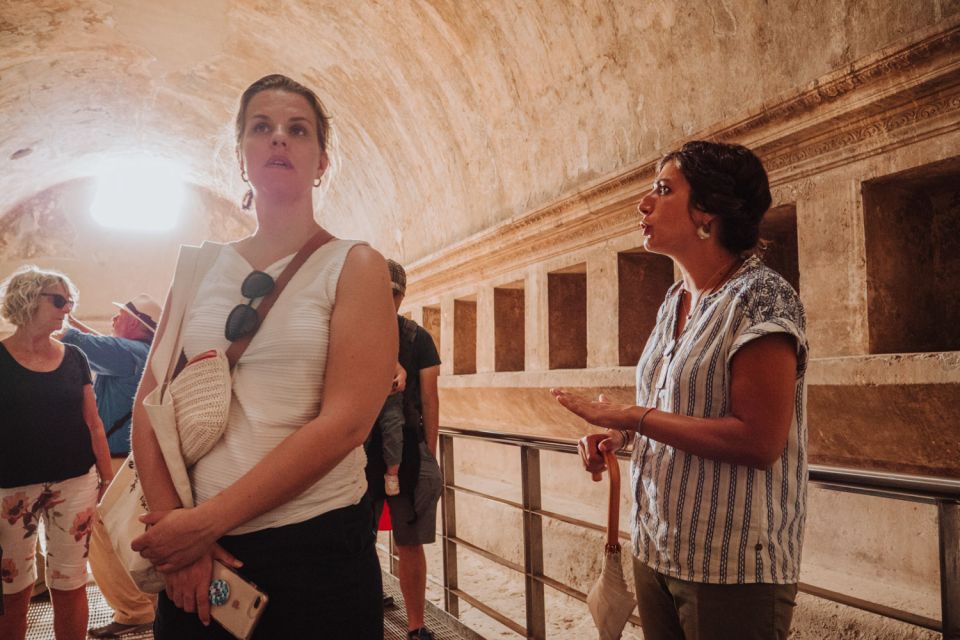
Pompeii hits the big stops fast: key buildings, a brothel, and plaster casts of people and animals.
Herculaneum feels more human scale: House of Neptune and Amphitrite plus a beach area where skeletons are preserved.
Your guide is the star: you may get archaeologists such as Michele, Julia, Diego, Sergio, or Paolo, with headsets to keep you with the group.
Efficient Rome logistics: train to Naples in about 70 minutes, then comfy minibus hops between sites.
Wear solid shoes: sandals, flip-flops, and high heels are not allowed for a reason.
In This Review
- Rome to Pompeii and Herculaneum With a High-Speed Train Plan That Actually Works
- Naples Meeting Point: How to Find Your Guide Without Stress
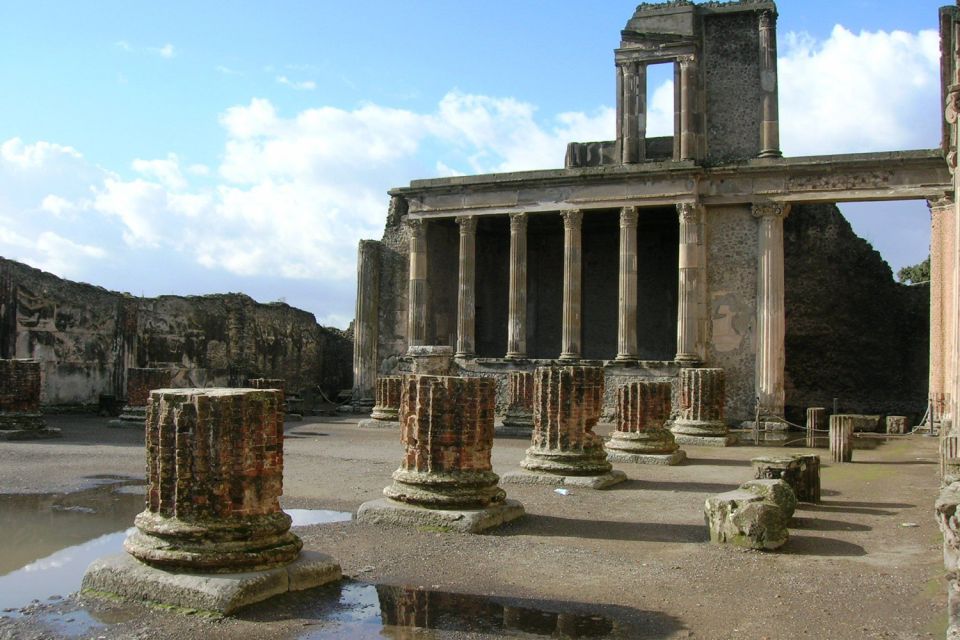
- Pompeii’s Guided Tour: What You’ll Actually See (Not Just Wander Past)
- The Pompeii Free Time Window: How to Use 30 Minutes Smart
- The Jump to Herculaneum: Why Both Sites in One Day Makes Sense
- Herculaneum’s House Tour Feel: Less Crowded Energy, More Life-Like Details
- Walking, Shoes, and the Reality of Uneven Stone Paths
- Timing and Pacing: The Trade-Off for Seeing Two Sites
- Price and Value: What You’re Really Paying For at About $222
- Who Should Book This (And Who Might Want a Different Plan)
- Should You Book This Rome Day Trip to Pompeii and Herculaneum?
- FAQ
- How long is the Pompeii and Herculaneum day trip from Rome?
- What’s the route for getting from Rome to Naples and then to the ruins?
- Where do I meet the guide in Naples?
- Are the tours guided, and is there headset support?
- Do I need to pay for site tickets separately?
- Are meals included?
- How much walking is involved?
- What should I bring, and what’s not allowed?
- Is the tour available in English?
- What if it rains?
Rome to Pompeii and Herculaneum With a High-Speed Train Plan That Actually Works
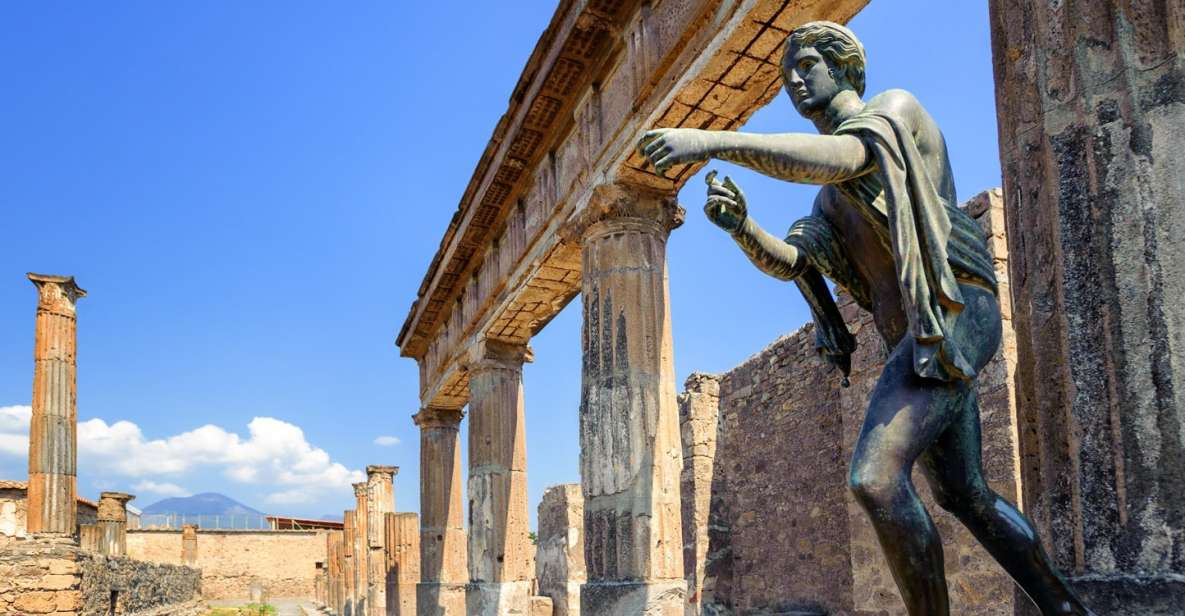
If you only have one full day away from Rome, this is one of the cleaner ways to pull off Pompeii plus Herculaneum. The core idea is simple: you trade the slow grind of buses for a fast rail link to Naples, then use short minibus transfers to reach the ruins.
You start at Roma Termini. You travel independently by the pre-booked high-speed train to Naples Central Station, and then meet your guide just outside the station—specifically in front of the STARHOTEL TERMINUS entrance across from the station, with an ASKOS TOURS sign. From there it’s a smooth rhythm: minibus hop to Pompeii, guided time there, quick transfer to Herculaneum, then the reverse back to Naples and Rome.
What makes this feel “worth it” is that you don’t spend your day fighting schedules. The tour is built around transport timing, and it stays guided enough that you aren’t standing around wondering where to go next.
Naples Meeting Point: How to Find Your Guide Without Stress
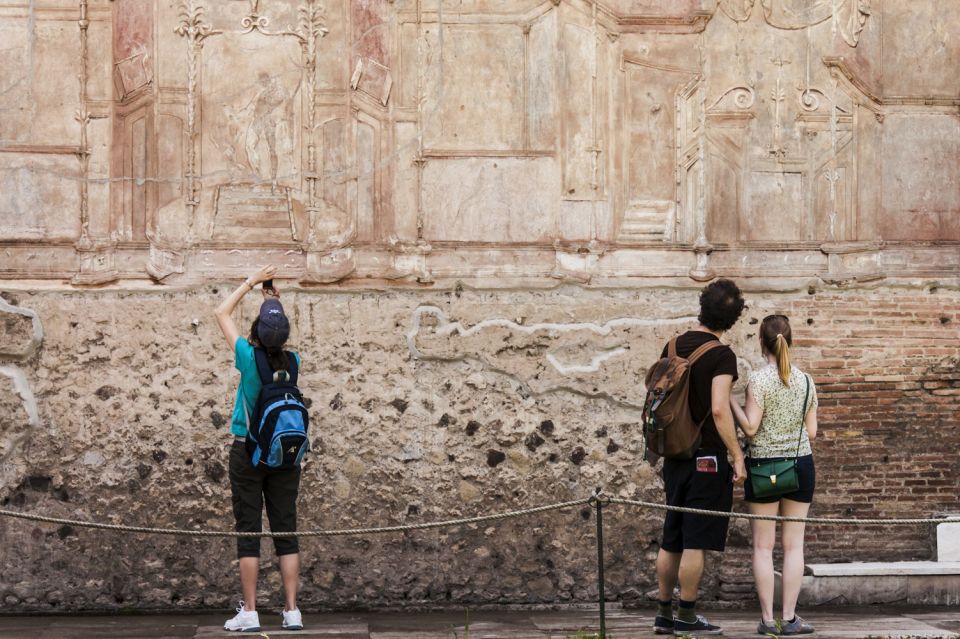
Naples Central Station is not hard, but it can be confusing if you arrive late or get turned around. The good news: your meeting instructions are very specific.
Here’s what you should do:
- Arrive early at Roma Termini so you can get to the train without last-minute station chaos.
- When you reach Naples, look for the guide by the STARHOTEL TERMINUS entrance opposite the station.
- Expect an English-speaking guide holding the ASKOS TOURS sign.
You’ll get headsets for all participants, which is a big deal in ruins. It means you can keep moving with the group instead of constantly turning your head to find the next piece of commentary.
You can also read our reviews of more tours and experiences in Rome.

Pompeii’s Guided Tour: What You’ll Actually See (Not Just Wander Past)
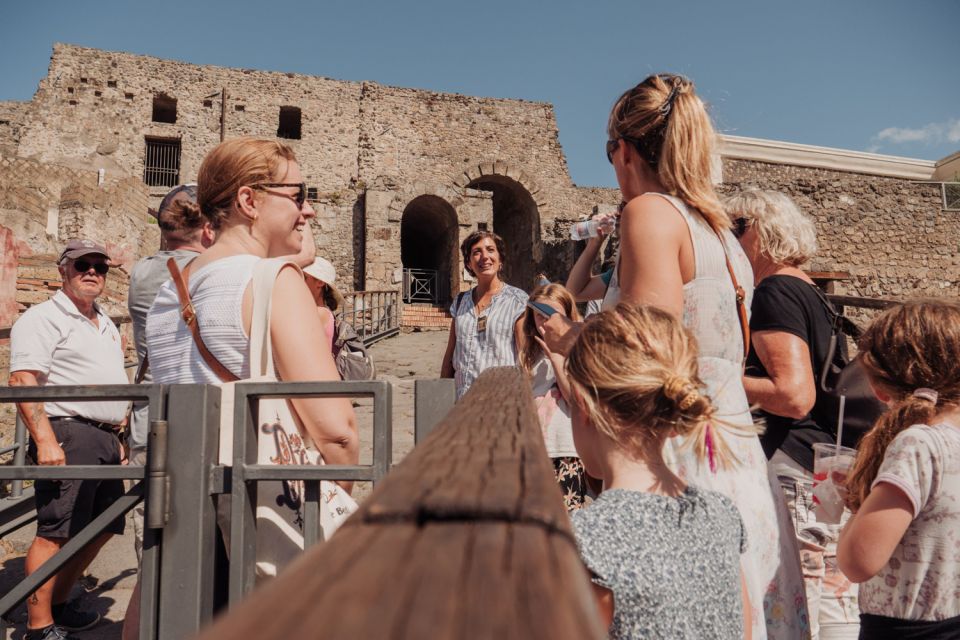
Pompeii is the loudest name on the map, but this day trip gives it structure. Instead of you guessing what to prioritize, you get a guided route that focuses on the kinds of places that make Pompeii feel like a real city.
Your Pompeii portion includes:
- A guided tour for about 2 hours
- A free time window for about 30 minutes afterward
During the guided part, you’re set up to hit Pompeii’s key areas such as:
- Newly opened houses (a reason this can feel fresher than older Pompeii tours)
- The plaster casts of victims, and even casts of animals
- The brothel
- Other important buildings tied to how the city worked
The plaster casts deserve extra attention. Seeing bodies represented this way turns the eruption story from something abstract into something visual. It’s also the kind of stop that works especially well with an archaeologist guide, because you’ll hear how interpretations are built from material evidence, not just dramatic storytelling.
Guides on this tour are often described as both entertaining and tightly organized—Raphael and Sergio come up for that mix of humor and clarity. That matters because Pompeii rewards focus. If you’re loosely following along, you can miss the connections between street life, architecture, and what the eruption meant for the people there.
The Pompeii Free Time Window: How to Use 30 Minutes Smart
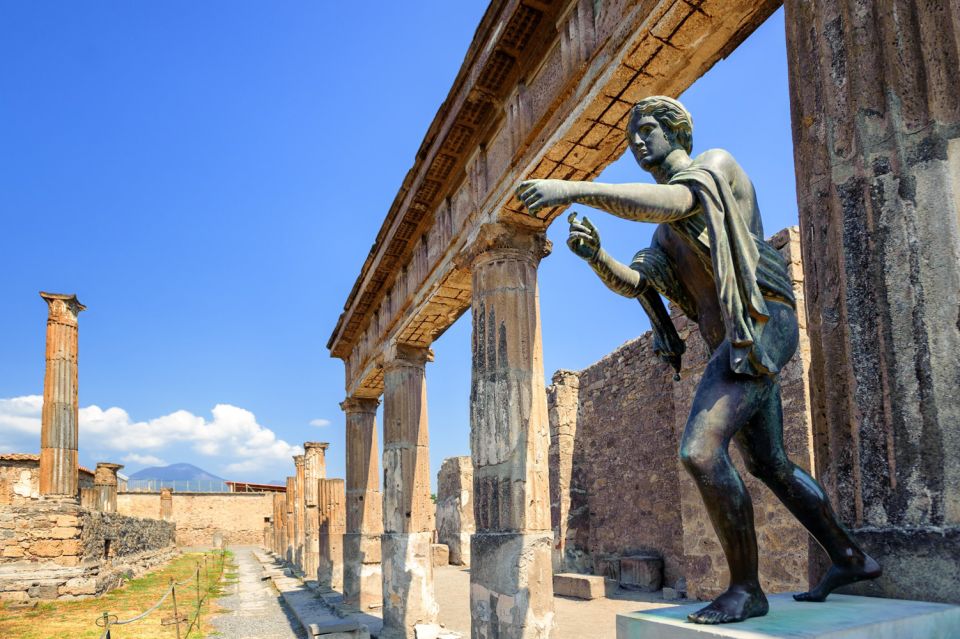
That 30 minutes of free time in Pompeii is short. It’s enough to grab something quick, use the restroom without panic, or buy a small souvenir. It is not enough to treat Pompeii like a choose-your-own-adventure day.
Here’s how I’d use it:
- If lunch is important to you, decide before you arrive where you’ll go.
- If pictures matter, use the free time to get shots you missed during the guided route—especially from angles that the group pace can’t cover.
- Don’t plan on sitting down long. This tour is designed around moving you to Herculaneum afterward.
A number of groups note that Pompeii can feel rushed, especially if you want museum-style time or lots of Forum photos. That doesn’t mean the tour is badly run. It means you should set expectations: the day is engineered to include both sites, so Pompeii isn’t given the kind of time you’d want if this were a Pompeii-only visit.
The Jump to Herculaneum: Why Both Sites in One Day Makes Sense
After Pompeii, you transfer by minibus to Herculaneum. The time on the ground changes here: Herculaneum is more compact, and the preserved elements can make it feel more intimate than Pompeii’s big urban sprawl.
Your Herculaneum portion is:
- Guided tour for about 2 hours
- Plus the built-in focus stops your archaeologist guide leads you to
You’ll visit highlights such as:
- The House of Neptune and Amphitrite
- The beach area where skeletons are preserved
One reason I like pairing Pompeii and Herculaneum is that it gives you two different ways to understand the same disaster. Pompeii shows a citywide story through famous public and residential areas. Herculaneum—because the houses and streets are preserved—helps you picture life at ground level: doorways, rooms, street corners, and the grim reality of what happened there.
Herculaneum’s House Tour Feel: Less Crowded Energy, More Life-Like Details
Herculaneum’s charm is the scale. Even when crowds are present, it doesn’t feel like you’re racing across a giant site.
With an archaeologist guide, you typically get:
- Architecture explained as evidence, not just decoration
- Room-by-room context tied to daily living
- A clear story about what you’re seeing and why it survived
In guides described as exceptional—Michele is mentioned a lot, as is Paolo—one theme shows up: they keep commentary flowing. The group doesn’t feel like it’s waiting for “the next stop.” You’re hearing explanations as you move, which makes the time feel more coherent.
Also, Herculaneum is where stops like the skeleton beach land with extra weight. It’s not just tragedy for tragedy’s sake. It’s the physical result of the eruption, visible because the site preserved more than what an open ruin might normally preserve.





Walking, Shoes, and the Reality of Uneven Stone Paths
This is a practical ruins tour, so your body has to cooperate.
You should plan for:
- About one mile of walking in Pompeii
- About half a mile of walking in Herculaneum
- Uneven, stone-paved surfaces typical of both archaeological sites
You’re also asked not to wear:
- Sandals or flip-flops
- High-heeled shoes
And you should avoid bringing:
- Luggage or large bags
If you have mobility concerns, the tour isn’t recommended. Even if you can handle some walking, these sites can be hard on knees and ankles. The minibus transfers help, but once you’re in the ruins, you’ll be moving at a group pace.
Weather is “rain or shine.” Bring a raincoat if needed. The tour keeps going, so you’ll want shoes that can handle damp stone without turning slick.
Timing and Pacing: The Trade-Off for Seeing Two Sites
This day trip runs about 8.5 hours. Trains are a huge part of the reason it works: high-speed trains take you between Rome and Naples in about 70 minutes each way.
The schedule is built like this:
- Train Rome → Naples (about 70 minutes)
- Minibus drive Naples → Pompeii (about 30 minutes)
- Pompeii guided time (about 2 hours)
- Pompeii free time (about 30 minutes)
- Transfer to Herculaneum (about 30 minutes)
- Herculaneum guided time (about 2 hours)
- Minibus back to Naples (about 30 minutes)
- Train Naples → Rome (about 70 minutes)
That means Pompeii gets the guided highlights, not a full unhurried exploration. Herculaneum similarly gets a focused guided slice.
You’ll probably feel the pacing is good if you want the big story and the major highlights. If you want a slow, photo-heavy day with optional museum time, you may feel squeezed.
Price and Value: What You’re Really Paying For at About $222
At $222.77 per person, you’re not just paying for tickets to Pompeii and Herculaneum. You’re paying for a whole bundle:
- Round-trip high-speed train tickets from Rome to Naples
- Minibus transfers between Naples and both sites
- Guided tours with an archaeologist at Pompeii and at Herculaneum
- Pompeii Express entry tickets and Herculaneum entry tickets
- Headsets so you can hear the guide clearly
Here’s the value logic: Pompeii alone can eat up most of a day with logistics and navigation. This plan builds the day so you see the two sites without losing half your hours to transit, ticket lines, or guesswork.
Is it pricey compared to doing it by yourself? Sure. But if you’re paying for an archaeologist guide in both places plus train and transfers, the cost starts to look more like a “transport + interpretation package,” not just museum entry.
If your main goal is to understand what you’re seeing—why the buildings look the way they do, what the eruption meant for real people—this price tends to make sense.
Who Should Book This (And Who Might Want a Different Plan)

This tour is a great fit if you:
- Want Pompeii and Herculaneum in one day without the stress of planning transit between them
- Like explanations while you walk, not just wandering with a phone app
- Appreciate a guide who can answer questions and connect the ruins into a clear story
- Want to see signature stops like the plaster casts in Pompeii and the House of Neptune and Amphitrite plus preserved skeletons at Herculaneum
I’d think twice if you:
- Have limited mobility or need a fully accessible route (this isn’t designed for wheelchair users or limited mobility)
- Want a relaxed pace with lots of time for lunch and photos at each site
- Expect meals included (meals are not included)
Should You Book This Rome Day Trip to Pompeii and Herculaneum?
If your travel style is: one day, two major sites, and a guide who knows how to explain the evidence, then yes, book it. The biggest payoff is the structure. You’re not improvising Rome-to-Naples-to-ruins logistics. You’re showing up, meeting your guide, and getting a guided route that hits the stops most people come for.
But go in with the right expectations: Pompeii is a highlight tour, not a slow-day deep wander. If you’re okay with a packed schedule and you wear proper walking shoes, this is one of the more efficient and most insight-rich ways to experience Vesuvius-era Campania from Rome.
FAQ
How long is the Pompeii and Herculaneum day trip from Rome?
The total duration is listed as 8.5 hours.
What’s the route for getting from Rome to Naples and then to the ruins?
You travel independently by the provided high-speed train from Roma Termini to Naples Central Station (about 70 minutes). Then you take a van/minibus to Pompeii (about 30 minutes), and later you transfer the same way to Herculaneum and back to Naples (with similar transfer times).
Where do I meet the guide in Naples?
Meet the guide in front of the STARHOTEL TERMINUS entrance located opposite Naples Central Station, and look for the guide holding an ASKOS TOURS sign.
Are the tours guided, and is there headset support?
Yes. The experience includes guided tours at both Pompeii and Herculaneum with an archaeologist, and headsets are provided for all participants.
Do I need to pay for site tickets separately?
The tour includes Pompeii Express entry tickets and Herculaneum entry tickets (listed as 16.00 euros each).
Are meals included?
No, meals are not included.
How much walking is involved?
The tour notes about one mile of walking in Pompeii and half a mile of walking in Herculaneum.
What should I bring, and what’s not allowed?
Bring a passport or ID card. You can’t wear sandals or flip-flops or high-heeled shoes, and luggage or large bags are not allowed.
Is the tour available in English?
Yes, the live tour guide is English.
What if it rains?
The tour runs rain or shine. A raincoat is recommended if needed.