REVIEW · ROME
From Rome: Ostia Antica Guided Half-Day Trip by Train
Book on GetYourGuide →Operated by City Wonders Ltd. · Bookable on GetYourGuide
Roman port life feels close-up.
This half-day trip to Ostia Antica is an easy train ride out of Rome, then a guided walk through a former commercial and military harbor where the everyday details still show. I especially like how the guide turns ruins into a story you can follow street by street, not just a list of monuments.
Two things I like a lot are the small group size (limited to 12) and the way the tour focuses on real, lived-in spaces. You’re led along the main Decumanus Maximus, with statues lining the walkways, plus you get stops at the Baths of Neptune, the amphitheater, and the public Forica, where you see how ordinary Roman routines worked.
One consideration: the site is built on archaeological ground and it is not suitable for wheelchair users, and baby strollers aren’t allowed. Wear comfortable shoes because you’ll be walking for hours, and it can be hot and bright, especially in warmer months.
In This Review
- Key things worth marking on your mental map
- Why Ostia Antica feels different from the usual Rome ruins
- Train logistics from central Rome: simple in theory, smooth in practice
- Meeting at Cafe Piramide: how to avoid the first-minute scramble
- The 3-hour guided walk: how the port town reads street by street
- A smart break-and-look approach
- Baths of Neptune: the mosaic that makes the ruins feel alive
- Amphitheater + 3,500 seats: public spectacle in Roman scale
- Forica washrooms: the most human stop in Ostia Antica
- What you’ll likely do after the tour ends in Rome
- Price and value: what $58 buys you, and what it doesn’t
- Practical tips so your feet and plans survive
- Should you book this Ostia Antica guided half-day tour?
- FAQ
- How long is the Ostia Antica guided half-day trip?
- Where do I meet, and how do I recognize the group?
- Is transportation included from Rome to Ostia Antica?
- What ancient sites are included in the guided portion?
- Is there time for a break during the tour?
- Can I stay in Ostia Antica or go to the beach after the tour?
- Is the tour suitable for wheelchair users or strollers?
Key things worth marking on your mental map
- Train included, stress reduced: you get the return train ticket from Rome to Ostia Antica, with the guide handling the rail logistics.
- Decumanus Maximus on foot: the main thoroughfare helps you understand how traffic, goods, and people moved through the port town.
- Baths of Neptune mosaic: you’ll see the sea god scene, drawn by a 4-horse chariot.
- Amphitheater built for 3,500: the scale hits harder when you’re standing where crowds once sat (12 BC).
- Forica washrooms, up close: the marble bench with 20 well-spaced holes along four walls is the most human stop.
- Stay after the tour if you want: linger in Ostia Antica and the modern town, or head to the beach.
Why Ostia Antica feels different from the usual Rome ruins
Ostia Antica is Rome’s port city, not its “headline” city. Founded in the 4th century BC and once home to more than 100,000 people, it gives you the sense of an urban machine—commerce, shipping, public life, and leisure—working day after day. You get the rise and fall explained while you walk, which matters because the ruins are spread out and you need a thread to keep them connected.
I also like that Ostia tends to feel calmer than the famous sites closer to the center of the tourist map. That quiet lets you actually notice details like shop-like spaces, warehouses, and the public buildings that held daily routines. When there are fewer people competing for the best angles, the site reads more clearly.
You can also read our reviews of more guided tours in Rome


Train logistics from central Rome: simple in theory, smooth in practice
The tour is built around an easy half-day timeline: travel by train, then a guided visit, then travel back. You’ll depart from Piazzale Ostiense, and the ride to Ostia Antica is about 15 minutes. After the 3-hour guided portion, you’re back on the train roughly 20 minutes later.
This is a big part of the value. You’re not juggling connections, buying tickets on the fly, or trying to figure out where the group is meeting once you arrive. The guide accompanies you on the train, and your included return ticket means you can focus on the ruins instead of the schedule.
One timing note you should keep in your head: the tour service ends back in Rome at the Piramide Metro Station around 1:00 PM. If you want to stay in Ostia Antica or in the modern town, you’re free to do it, but your return journey would be unescorted. You still have the train ticket provided, so it’s not a blind leap, just a switch in how the day is supported.
Meeting at Cafe Piramide: how to avoid the first-minute scramble
Meet at Cafe Piramide. When you’re facing the Piramide Metro (Line B, the blue line), step to your right-hand side and look for the café in view of the train tracks and the train exit. It’s recognizable by the white umbrellas outside, which is the kind of small detail that saves time.
Guides will have a City Wonders sign with the name of the tour. That’s helpful because the meeting point is right where foot traffic mixes with metro arrivals, so you don’t want to be guessing. Show up a few minutes early, especially if you’re coming from Termini or any busier connection—getting your bearings early keeps the day calm.
Also note: hotel pickup and drop-off aren’t included. This is a “meet at the point, then go” tour, so plan to reach Piramide and Piazzale Ostiense on your own.
The 3-hour guided walk: how the port town reads street by street
The guided portion is where this tour becomes more than a ticket. You’ll get a comprehensive account of Ostia’s rise and fall as you explore the commercial and military seaport of the Roman Republic. That context is what turns scattered ruins into a functioning town.
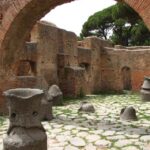
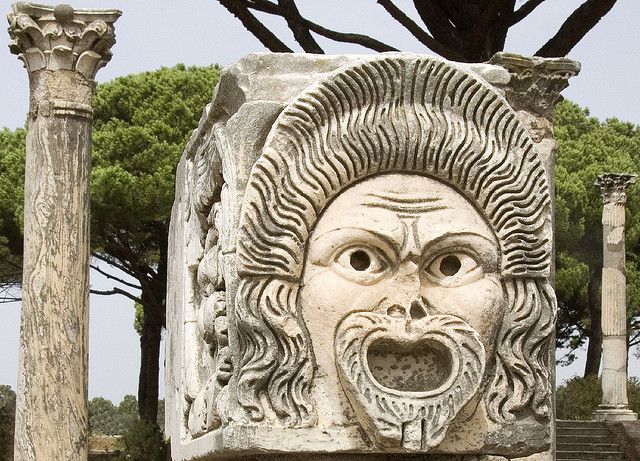
The walking route is anchored by the main Decumanus Maximus thoroughfare. This is the spine of movement—think major street, not a scenic byway. As you go, you’ll pass through areas like taverns and thermal baths, plus warehouses and theaters that reflect both everyday needs and public entertainment. Statues line the walkways, so you’re not just seeing walls; you’re seeing how public space was decorated and used.
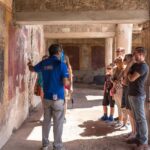
The guide’s job here is practical: keep you moving, point out what you might otherwise miss, and explain how these buildings likely worked. Some guides use stories and reenactment-style moments to make it feel less like museum reading and more like Roman street life. Even if your style preference is straightforward facts, this kind of interpretation helps you “see” what’s gone—building heights, street-level life, and the rhythm of the port.
A smart break-and-look approach
You’ll have a toilet break with time for a snack and/or drink at the snack bar. Because the ruins are spread out, those short pauses matter. Use them to reset your legs and your eyes—then you’ll be ready to appreciate the mosaics and floor details later.
You can also read our reviews of more tours and experiences in Rome



Baths of Neptune: the mosaic that makes the ruins feel alive
One stop you’ll remember is the Baths of Neptune. These baths are topped with an impressively intact mosaic showing Neptune, the sea god, being drawn by a 4-horse chariot. You’re looking at art that was built into the public rhythm of Roman life: bathing, talking, and being seen.
Baths mattered in the ancient city. They were not just for cleaning; they were social hubs. When you see the mosaic in place, it’s easier to imagine what kind of mood people wanted inside—bright, decorative, and connected to the sea, which makes sense for a harbor town.
If you’re trying to prioritize just one “wow” moment in your head, this is a strong candidate. It’s iconic, visual, and it’s in context, not dropped into a random display room.
Amphitheater + 3,500 seats: public spectacle in Roman scale
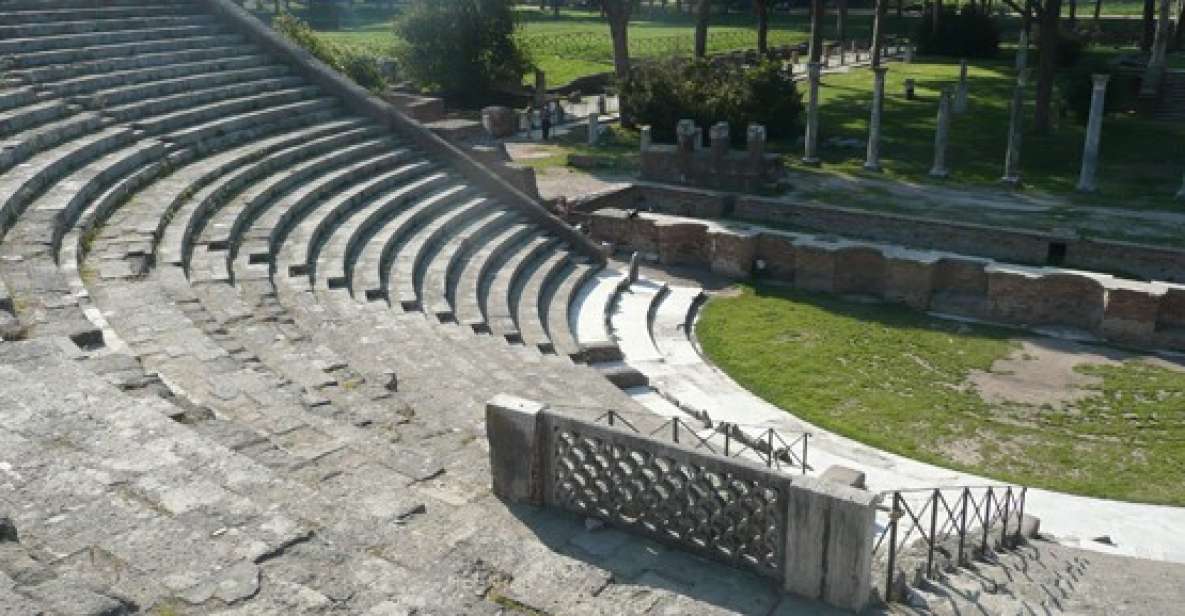
Next comes the amphitheater. It was built around 12 BC and designed for about 3,500 spectators. That number changes how you feel standing in the area—you can picture crowds rather than just counting stones.
The amphitheater also helps you understand that Ostia was not only about shipping and work. People needed entertainment that matched the energy of a busy port city. The guide helps you imagine the roar of the crowds, which fits the architecture: your viewpoint and the building’s shape do the convincing once someone gives you the context.
One practical note: amphitheater seating areas can mean more uneven ground and more sun exposure, depending on the day. Bring your sunscreen habit, even if you think you won’t. A half-day can still turn your neck into a souvenir.
Forica washrooms: the most human stop in Ostia Antica
The Forica (public washrooms) is one of the best reasons to take a guided tour here. You’ll see a marble bench lined with 20 well-spaced holes along four walls of a large open room. It’s a rare moment where the ruins feel specific enough to be everyday, not just impressive.
This is the stop that makes the site memorable because it’s tied to a basic human routine. The design also shows you how Roman public space worked—shared, planned, and built with a standard pattern. Sitting in the space for a moment gives you a stronger mental picture than looking at it from the edge of a platform.
It’s also the part that makes you smile a little, in a thoughtful way. It’s ancient Rome, but it’s still life: sanitation, movement, and the basic infrastructure of a city that handled more than 100,000 residents at its peak.
What you’ll likely do after the tour ends in Rome
After the guided portion, you can stay in Ostia Antica and the modern town at your leisure. If you’re the type who likes to wander with slow curiosity, this is a great option. You’ll have time to roam around the archaeological park after you’ve already gotten the big picture.
There’s also the beach option nearby, which is why the tour encourages you to bring a towel and beachwear. If you’ve spent days in Rome’s museums and ruins, this is a nice change of pace. It also lets you turn the half-day archaeology into a fuller local outing.
If you plan to check the on-site museum, keep in mind that in winter it may close earlier—around 1:30 PM. Since your tour wraps up around 1:00 PM back in Rome, that timing can matter if you’re staying in Ostia after the guide finishes.
Price and value: what $58 buys you, and what it doesn’t
At about $58 per person for a 4-hour experience, the value is really in the bundle. You’re paying for the return train ticket from Rome to Ostia Antica, the entry ticket, and the guide. That’s a lot easier than organizing transport and figuring out where to start once you arrive at the archaeological park.
You’re also paying for interpretation. Ostia is large enough that it can feel like “more ruins” if you walk it solo. A guide helps you hit the most meaningful features in your limited time—Decumanus Maximus, Baths of Neptune, the amphitheater, and the Forica—without wasting energy guessing.
What’s not included is hotel pickup and drop-off. So your real cost isn’t just money; it’s planning your way to Piazzale Ostiense and the meeting point at Cafe Piramide. If you’re already comfortable using Metro Line B, you’ll find the logistics easier than most day trips.
Finally, this tour is designed for a small group of up to 12. That matters because it keeps the attention level up and makes it easier to ask questions while you’re standing in the right spot.
Practical tips so your feet and plans survive
Bring comfortable shoes first. The ruins are archaeological and walking takes effort. Pack a towel and beachwear if you want to add the beach option after the guided segment. Sports shoes are recommended, especially if you plan any extra wandering after the tour.
Expect a toilet break during the day with time to snack or drink at the snack bar. That’s not just convenience; it helps you avoid rushing later when the sun is high and the group is moving.
For transport disruption: if there’s a strike or other unforeseen problem with public transport, a minibus will be provided at no extra cost to transfer participants to and from Ostia Antica. That’s a reassuring safety net, because train-based day trips live or die by the schedule.
And for families: baby strollers aren’t allowed. If you’re traveling with a stroller-age kid, plan for either carrying or choosing another option.
Should you book this Ostia Antica guided half-day tour?
Book it if you want an easy Rome day trip that actually explains what you’re seeing. This tour is strongest for people who like context and want to connect ruins to real routines—commerce streets, bathing culture, public events, and even public sanitation.
Skip it if you need wheelchair access. The tour isn’t suitable for wheelchair users, and the walking environment is not set up for that kind of mobility.
If you’re comparing this to the loudest, most crowded Roman-ruin days, I’d lean toward Ostia for the calmer feel and the “port city” angle. Add beach time if you can, and you’ll end the day with less sunburn regret and more of a full local rhythm—train out, guided walk, then your own pace along the coast.
FAQ
How long is the Ostia Antica guided half-day trip?
The total experience is about 4 hours, including train time and a guided visit of about 3 hours at Ostia Antica.
Where do I meet, and how do I recognize the group?
Meet at Cafe Piramide. When facing the Piramide metro (Line B – the blue line), stop on your right-hand side; the café is in view of the train tracks and the trains’ exit. Look for the white umbrellas, and the guides will have a City Wonders sign with the tour name.
Is transportation included from Rome to Ostia Antica?
Yes. The tour includes a return train ticket from Rome to Ostia Antica. The guide accompanies you on the train.
What ancient sites are included in the guided portion?
You’ll visit major highlights such as the main street Decumanus Maximus, the Baths of Neptune (with a well-preserved mosaic), the amphitheater, and the Forica public washrooms. You’ll also see other remains that reflect the port city’s commercial and everyday life.
Is there time for a break during the tour?
Yes. There will be a toilet break with time for a snack and/or drink at the snack bar.
Can I stay in Ostia Antica or go to the beach after the tour?
Yes. After the tour ends, you can remain in Ostia Antica and explore the modern town at your leisure, or you can go to a nearby beach. The service ends in Rome at about 1:00 PM, and if you return on your own, the return journey is unescorted (but train tickets are provided).
Is the tour suitable for wheelchair users or strollers?
No. The tour is not suitable for wheelchair users, and baby strollers are not allowed.