REVIEW · ROME
Rome: Galleria Borghese Museum Entry Ticket and Guided Tour
Book on GetYourGuide →Operated by TLight · Bookable on GetYourGuide
Tickets here are time-boxed for a reason. A guided visit to Galleria Borghese gives you a timed entry and a focused route through the rooms where the art actually makes sense, not just a pile of masterpieces. What I like most is the chance to see Caravaggio and Bernini highlights without wasting time hunting them down. The main drawback to consider is pacing: the tour is advertised for 2 hours, so you’ll want the full amount of guide time for what you’re paying.
You’ll move through standout spaces tied to the Borghese Collection’s story: Cardinal Scipione Borghese (nephew of Pope Paul V) was the driving force behind this collection, and the museum is arranged so you feel the curatorial logic. I especially love the way the ceiling frescoes add drama, including the Salone’s big fresco by Mariano Rossi, which uses foreshortening so well it feels almost three-dimensional.
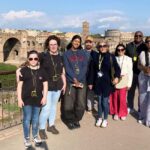
For logistics, it’s refreshingly straightforward. Meet at Piazzale Scipione Borghese, 5, and look for your guide’s red flag with the Saints Tour logo. Just bring an ID, pack light (no large luggage), and know it runs rain or shine.
In This Review
- Key things to know before you go
- Why Galleria Borghese tickets feel different from other Rome museums
- Getting to the meeting point: Piazzale Scipione Borghese and your red-flag guide
- The 2-hour flow: how the rooms are organized for maximum impact
- Ground-floor sculptures and the Borghese visual rhythm
- Salone ceiling frescoes: foreshortening you’ll notice immediately
- The Chamber of Ceres and the details worth slowing down for
- Caravaggio in the Borghese Collection: what you should expect to see
- Bernini sculptures: where the visit really turns Baroque (and why it matters)
- The Borghese collector angle that makes Bernini feel personal
- Ceiling frescoes and sculpture together: a smart “theater” effect
- Price and value: is $94 per person worth it?
- Watch-outs that can affect your experience
- Who should book this Borghese guided tour?
- Should you book this Galleria Borghese entry ticket and guided tour?
- FAQ
- What’s included with the Rome Galleria Borghese guided tour?
- How long is the tour?
- Where do I meet the guide?
- What languages are available?
- Is wheelchair access available?
- Is luggage allowed?
- What should I bring for entry?
- Is the tour affected by weather?
Key things to know before you go
- Timed entry plus a guide keeps you from spending your visit in lines and bottlenecks.
- Caravaggio coverage includes two paintings such as St John the Baptist.
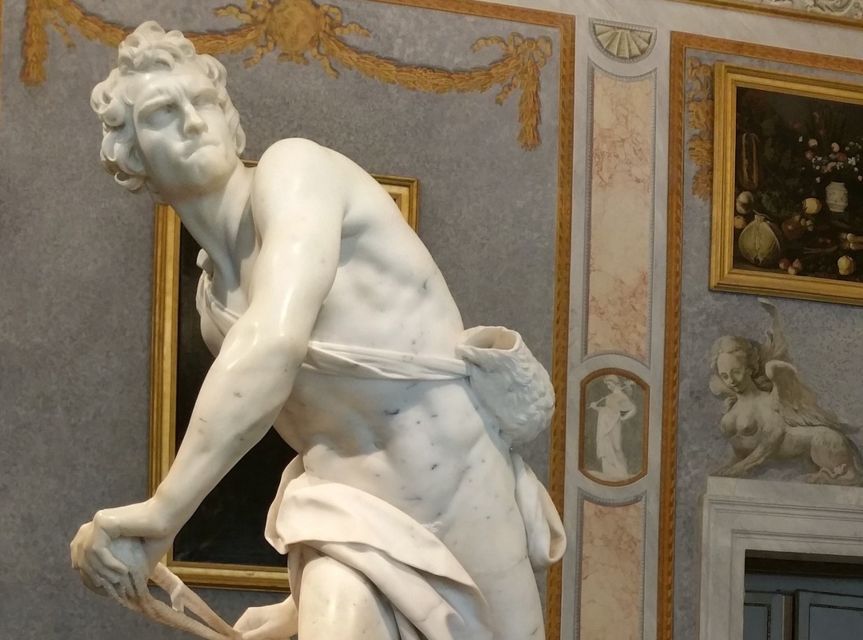
- Bernini highlights include Rape of Proserpine and Apollo and Daphne.
- Headsets are included, so you can hear the guide clearly even when rooms get busy.
- Ceiling frescoes are a major part of the experience, not background decoration.
- Meet at Piazzale Scipione Borghese, 5 with a red flag showing the Saints Tour logo.
Why Galleria Borghese tickets feel different from other Rome museums
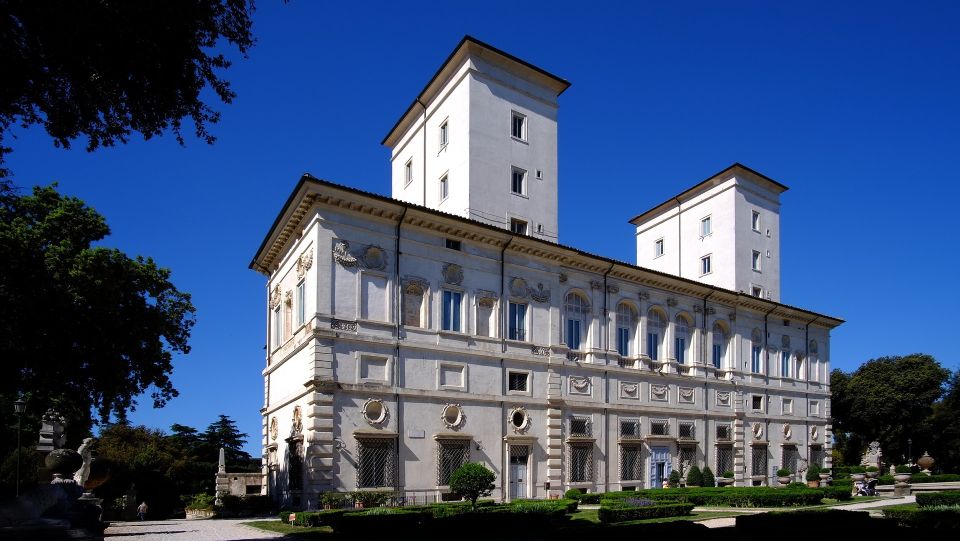
Galleria Borghese is one of those Rome stops where the entry system changes the whole experience. This is not a museum where you wander at your own pace for hours and still feel like you found the key works. A guided, timed entry matters because it helps you hit the right rooms in the right order while the building’s layout and themes stay clear.
The value here comes from what’s bundled. Your visit includes the entry ticket, a live guide, and headsets (plus an audio guide in French, Italian, or English). So you’re paying for interpretation and access together, not just for admission.
If you’re the type who likes to leave knowing what you just saw, the guide route can be the difference between I saw a lot of art and I actually understood why these pieces belong together.
You can also read our reviews of more tours and experiences in Rome


Getting to the meeting point: Piazzale Scipione Borghese and your red-flag guide
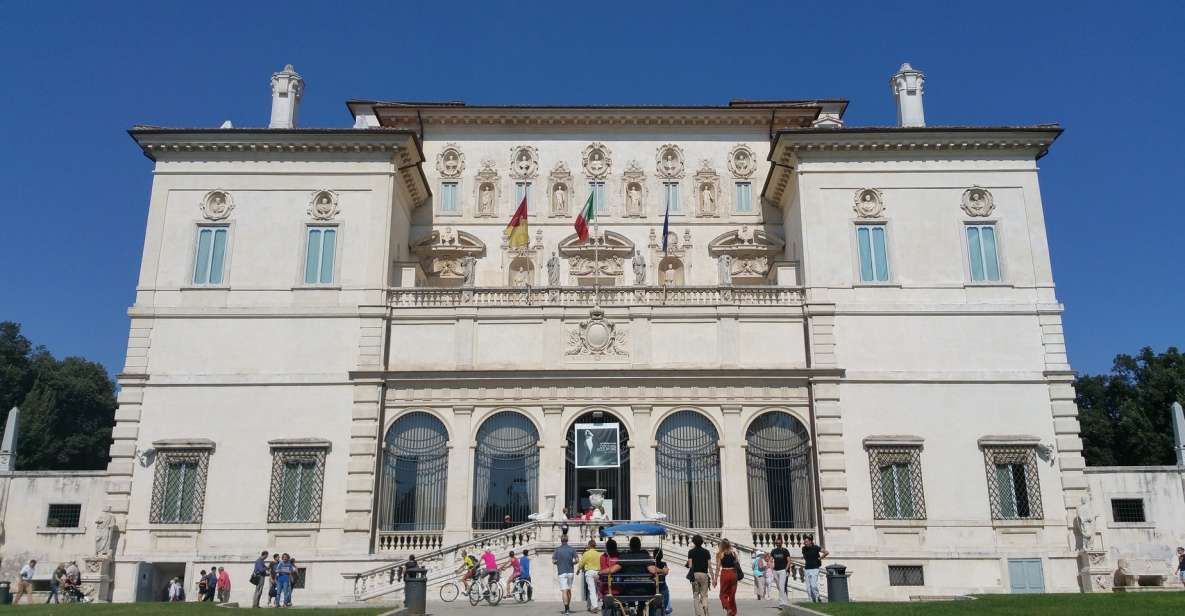
Your tour starts at Piazzale Scipione Borghese, 5. The meeting point is easy to miss only if you show up late or you’re looking at the wrong side of the plaza, so give yourself a buffer.
Look for your guide holding a red flag with the Saints Tour logo. That’s your visual cue—use it, don’t improvise. It’s also a comfort factor if you’re traveling with teens or a mixed group, because it reduces decision-making right at the start.
The tour languages are French, Italian, and English, and your guide can use that same language stream with the headsets so you’re not constantly trying to catch words over room noise.
The 2-hour flow: how the rooms are organized for maximum impact
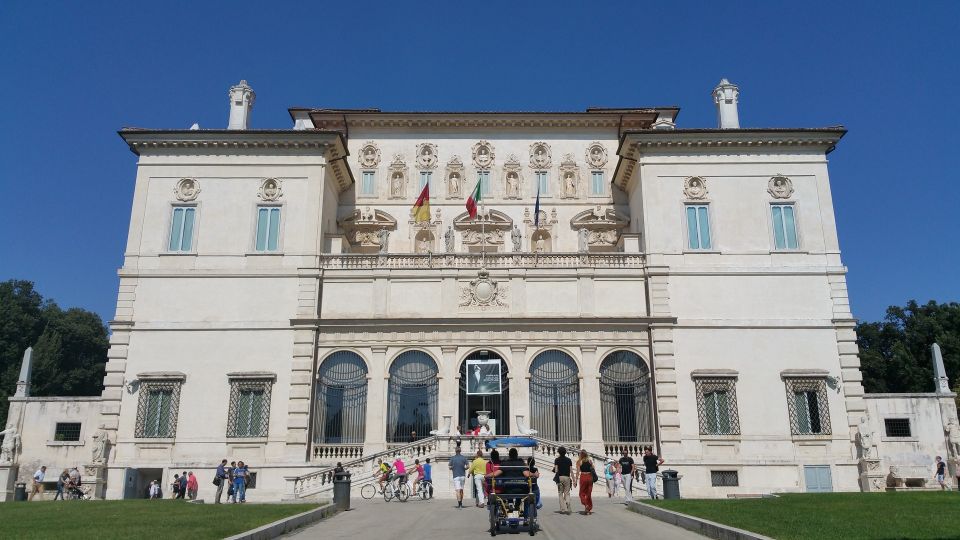
This visit runs about 2 hours, and the structure is built around movement from one themed space to the next. That matters because the museum isn’t just a gallery of statues and paintings—it’s a carefully arranged sequence.
You can expect a route that includes both sculptures and paintings areas, with stops that highlight specific works and the ceiling frescoes above you. Even if you think you’re only here for Bernini or only for Caravaggio, the sequence helps you notice how the museum’s “story” builds.
Ground-floor sculptures and the Borghese visual rhythm
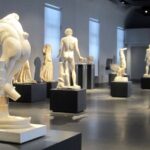
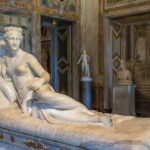
The tour covers the ground-floor sculpture focus, where the Borghese Collection makes its strongest impression. These works often feel like they’re frozen mid-motion, and having a guide pointing out what to look for makes it easier to see the technique—how bodies turn, how drapery frames faces, and how emotion is shaped.
A good guide also helps you manage priorities. You might only have a short window for each major work, so being told what to spend a little extra time on prevents that classic museum regret: I hurried past the one piece I cared about.
Salone ceiling frescoes: foreshortening you’ll notice immediately
One reason Galleria Borghese works so well is the artwork overhead. The Salone is highlighted by a large ceiling fresco by Sicilian artist Mariano Rossi. The painting depicts Marcus Furius Camillus relieving the siege of the Capitol by the Gauls.
Here’s the practical takeaway: ceiling frescoes can be hard to appreciate when you’re standing still with the rest of the crowd. With a guide, you get a cue for where to look and what to notice, especially with this fresco’s foreshortening effect. It’s designed to trick your sense of depth, so once you see the trick, you can’t unsee it.
The tour also moves through other ceiling moments. In the next room, the ceiling is frescoed by Francesco Caccianiga with the Fall of Phaeton. These ceilings aren’t random decoration; they’re part of the collection’s intellectual and visual atmosphere.
You can also read our reviews of more guided tours in Rome


The Chamber of Ceres and the details worth slowing down for
In the first room of the Salone sequence, you’ll reach the Chamber of Ceres. A marble vase here includes an image of Oedipus and the Sphinx.
This is the kind of stop where a guide earns their fee. Without direction, you may glance, snap a quick photo, and move on. With a guide, you understand that these details are a bridge between sculpture, mythology, and the household collector’s tastes.
Even if you’re not a mythology scholar, the value is in learning how to look. You start catching the museum’s logic: not just what the pieces are, but why the themes are placed where they are.
Caravaggio in the Borghese Collection: what you should expect to see
Caravaggio fans often come with a checklist, and the Borghese Collection supports that obsession. The collection includes two Caravaggio paintings, including St John the Baptist.
Caravaggio is represented in the wider Borghese holdings with works such as Boy with Basket of Fruit, Saint Jerome Writing, and Sick Bacchus, so you’re walking into an environment where his dramatic realism is part of the room mood—not an occasional detour.
The best way to experience Caravaggio in a museum like this is to not rush the lighting and expression. Caravaggio’s style is all about intensity—faces, gaze, and the way the scene feels lit from within. A guided route helps you hold that attention long enough to actually register the emotions, not just the fame.
If you only have two hours, Caravaggio is one of the places where you’ll be glad you picked a tour instead of trying to match highlights on your own.
Bernini sculptures: where the visit really turns Baroque (and why it matters)
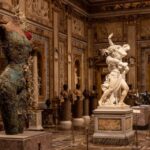
Bernini is the heart of many visitors’ experience at the Borghese, and for good reason. His work here includes major secular sculpture pieces, including Rape of Proserpine and Apollo and Daphne.
These are not just “famous statues.” They’re demonstrations of Baroque storytelling. You can see it in how motion is captured: bodies twist, hands stretch, and the emotional stakes feel immediate. In a typical museum setting, that can be lost if you’re standing too far away or moving too fast. A guide helps you position your attention so you can actually read the sculpture.
You’ll also likely connect this gallery to Bernini’s broader range, because the museum’s holdings include works from his earlier period too—examples often discussed include Goat Amalthea with Child Jupiter and Faun and Aeneas, Anchises and Ascanius. Later milestones you’ll hear about include David, often described as seminal for Baroque sculpture.
The Borghese collector angle that makes Bernini feel personal
What makes Bernini here feel different is the collector story around him. The Borghese Collection was driven by Cardinal Scipione Borghese, and the museum includes portrait busts tied to the family and patrons—such as Pope Paul V and portraits of Cardinal Scipione Borghese.
So when Bernini shows up, you’re not just seeing master craftsmanship. You’re seeing what a powerful collector valued enough to build a collection around. That context gives the sculptures a sharper emotional edge.
Ceiling frescoes and sculpture together: a smart “theater” effect
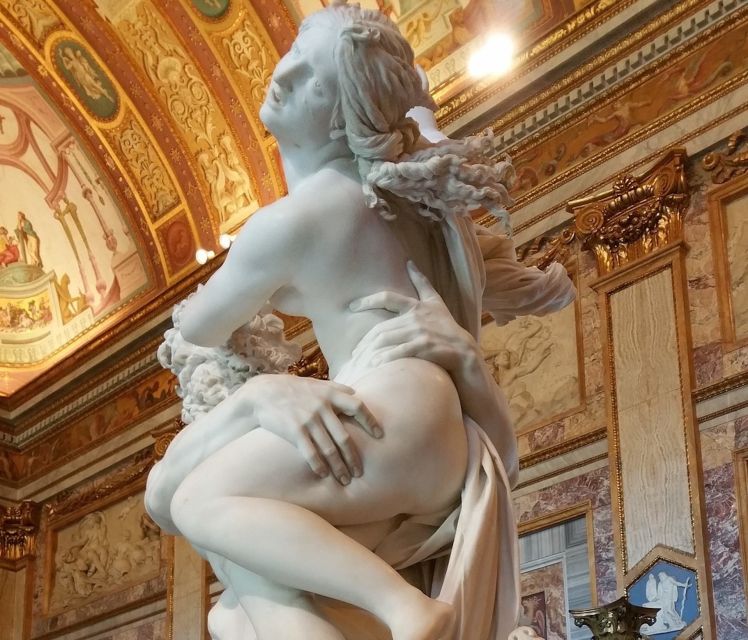
It’s easy to think you’re visiting art rooms. But in Galleria Borghese, you’re also inside a kind of visual theater. Ceiling frescoes—like Rossi’s foreshortening and Caccianiga’s Fall of Phaeton—work with the sculptural spaces below them. The ceiling adds scale, and the sculptures add body movement.
This combination is part of why a guided route helps. You can look up on your own, sure. But you might not know what the scene is, what to notice, or how it connects to the next room. With guidance, you stop treating the ceiling as wallpaper and start treating it like part of the main performance.
Price and value: is $94 per person worth it?
At $94 per person for a 2-hour guided experience, you’re paying a premium over a basic entry ticket. The key question is what you get that you’d struggle to replicate alone.
Here’s what’s included: the entry ticket, the guide, and headsets so you can hear clearly. You also get an audio guide in French, Italian, or English. That means your cost is buying time, interpretation, and comfort—especially in a museum where the layout can be confusing and time can feel tight.
So the value depends on your style. If you’re an expert who can already identify the works you want and knows how to sequence rooms efficiently, you might feel the price less justified. If you want to walk out with meaning—seeing Caravaggio’s presence and Bernini’s key narratives without second-guessing—then the guided format often feels like the smartest use of your time in Rome.
One more value note: the experience is rain or shine. That’s good news because you’re not gambling on the weather to get your art fix.
Watch-outs that can affect your experience
Nothing here is complicated, but a few things can change how smooth the day feels.
- Tour duration and pacing: The tour is advertised as 2 hours. If your visit starts in a way that compresses the time, you may miss depth on a couple of rooms—so watch the clock early and ask if you feel the schedule is shrinking.
- No large luggage allowed: If you’re traveling light, great. If you normally carry a big daypack or bags, plan to store them beforehand so you don’t lose time at security or inside the museum.
- Bring ID: You’ll need a passport or ID card. It’s a small thing, but forgetting it turns a smooth plan into a scramble.
Who should book this Borghese guided tour?
This is a strong choice if you:
- want to see Caravaggio and Bernini without spending your limited Rome time figuring out the museum flow,
- appreciate interpretation that explains what you’re looking at—especially in ceiling frescoes and sculpture details,
- are traveling with teens or mixed ages who benefit from a guide that can keep attention moving.
It may not be the best fit if you:
- prefer fully independent museum wandering and don’t want a structured route,
- dislike paying for guide time and would rather spend longer at just one work.
Should you book this Galleria Borghese entry ticket and guided tour?
If your budget allows it, I’d lean yes—especially because this experience ties together access, a focused route, and strong key-work visibility in only two hours. You’re not just buying admission to a famous building; you’re buying a way to understand it: Caravaggio’s intensity, Bernini’s motion, and frescoes overhead that shape how the rooms feel.
Book it if you want the highlights in a smart order and you’d rather spend your energy looking closely than planning on the spot. Skip it only if you’re a hardcore independent planner with a long list and plenty of time to repeat sections.
FAQ
What’s included with the Rome Galleria Borghese guided tour?
It includes your entry ticket, a live guide, and headsets to hear the guide clearly. An audio guide is also included in French, Italian, and English.
How long is the tour?
The duration is 2 hours.
Where do I meet the guide?
Meet at Piazzale Scipione Borghese, 5. Your guide will have a red flag with the Saints Tour logo.
What languages are available?
The live guide and the audio guide are available in French, Italian, and English.
Is wheelchair access available?
Yes, the experience is wheelchair accessible.
Is luggage allowed?
No large bags or luggage are allowed. Bring only what you need.
What should I bring for entry?
You should bring a passport or ID card.
Is the tour affected by weather?
The tour takes place rain or shine.